


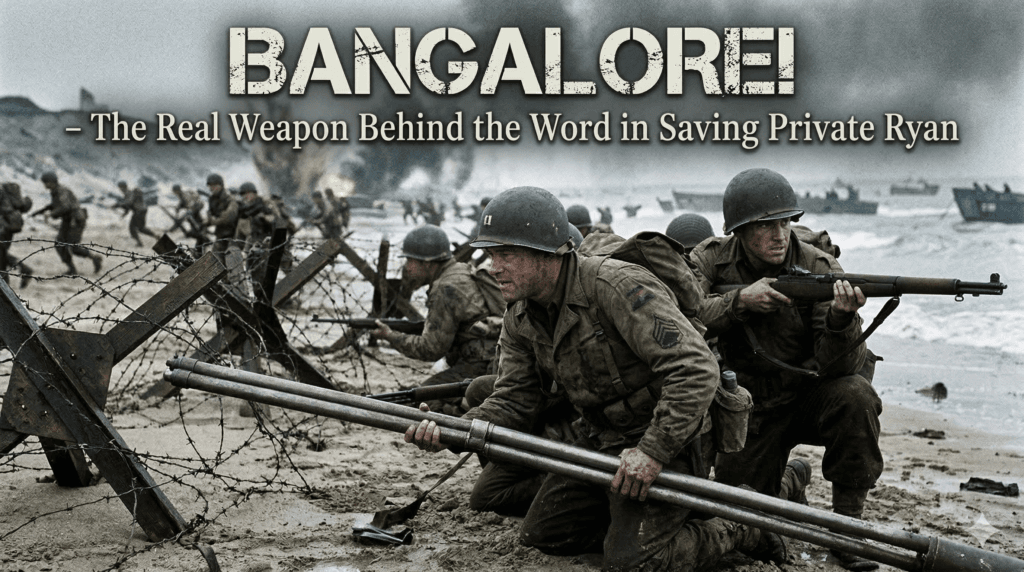
When soldiers in Spielberg’s D-Day masterpiece shout “Bangalore!”, they’re calling for one of history’s most ingenious — and lethal — pieces of military engineering.
If you’ve watched Steven Spielberg’s Saving Private Ryan — and if you haven’t, stop reading and fix that — you’ve heard it. Amid the deafening chaos of the Omaha Beach landing sequence, a soldier screams “Bangalore!” and a moment later, a chain of barbed wire erupts in a shower of sand and smoke, opening a narrow corridor through which terrified men scramble toward the bluffs. It’s one of the most viscerally effective scenes in modern cinema. But what, exactly, is a Bangalore?
The answer is the Bangalore torpedo: a slender, tube-shaped explosive device designed for a very specific and very dangerous job — clearing obstacles in the field without requiring a soldier to physically crawl up to them and risk being shot.
The Bangalore torpedo was invented in 1912 by Captain McClintock of the British Indian Army’s Madras Sappers and Miners — at Bangalore, India, which is exactly where the device gets its name.
Born in British India
The story of the Bangalore torpedo begins not on the beaches of Normandy, but in the sun-baked garrison town of Bangalore in southern India, more than three decades before D-Day. In 1912, Captain R.L. McClintock of the British Indian Army’s Madras Sappers and Miners was tasked with a persistent problem: how to detonate old minefields and barbed wire obstacles left over from the Boer War and the Russo-Japanese War without unnecessarily endangering soldiers. His solution was elegant in its simplicity — a metal tube packed with explosive that could be pushed along the ground and extended using additional sections, like screwing together a series of pipes, until it reached the obstruction.
The design was adopted broadly during World War I, when trench warfare turned barbed wire into one of the defining horrors of the battlefield. Soldiers attempting to cross No Man’s Land were frequently cut down trying to break through it. The Bangalore torpedo gave engineers a fighting chance — literally.
How it works
A standard Bangalore torpedo consisted of steel tubes, typically about five feet long and two inches in diameter, filled with explosive — usually ammonal, TNT, or similar compounds. Tubes could be screwed end-to-end, allowing engineers to push the assembled device deep under entanglements of wire or across a minefield from a relatively safe position. Once in place, a fuse was lit and the crew retreated. The resulting explosion didn’t just cut wire — it blasted a lane wide enough for men to run through, flinging debris outward and detonating any mines along its path.
The critical advantage was standoff distance. Rather than a sapper crawling up to clip wire by hand — under fire, in the open — a small team could assemble and deploy the torpedo from cover, dramatically improving their odds of surviving the operation.
“The Bangalore torpedo didn’t just clear wire. It cleared the way for men who had no other chance.”
June 6, 1944: Omaha Beach
By World War II, the Bangalore torpedo was standard-issue for combat engineers and Army Rangers. On D-Day, the U.S. Army Rangers and infantrymen storming Omaha Beach faced a nightmare obstacle course — multiple belts of barbed wire, mines, anti-tank obstacles, and interlocking fields of machine gun fire. Casualties in the first wave were catastrophic. Getting through the wire wasn’t optional; it was the difference between the landing succeeding or collapsing entirely.
Rangers and engineers crept forward under withering fire, assembled their Bangalore torpedoes section by section, shoved them beneath the wire, and blew gaps in the German defenses. These small, brutal acts of bravery — often by men who did not survive them — created the lanes through which subsequent waves of soldiers were able to advance off the beach.
Spielberg gets it right
Spielberg and his production team went to extraordinary lengths to achieve historical accuracy in Saving Private Ryan, and the use of the Bangalore torpedo is one of dozens of authentic details embedded in the film. When Rangers are shown assembling the device — screwing sections together while bullets kick up sand around them — that’s not dramatic license. That’s how it was actually done. The call of “Bangalore!” across the beach is shorthand for “bring up the torpedo,” a standard piece of military communication that audiences in 1944 would have recognised instantly, even if modern viewers need a moment to catch up.
The film’s unflinching depiction of what it cost to deploy those torpedoes — men dying while others shoved metal tubes through the sand — is perhaps the most honest account of what combat engineering looked like under fire.
Still in service
Here’s where history takes a quietly astonishing turn: the Bangalore torpedo never really left. The U.S. military still uses a variant called the M1A2 Bangalore torpedo. It shows up in training manuals, field exercises, and has seen deployment in conflicts decades after Normandy. The basic design — modular tubes of explosive, shoved through obstacles from a distance — has proven so effective that engineers haven’t felt the need to replace it. A device conceived in a British Indian garrison over a century ago is still clearing wire in the twenty-first century.
That longevity speaks to the quiet genius of McClintock’s original design: brutally simple, tactically indispensable, and easy enough to manufacture and use in the fog of combat. The Bangalore torpedo is one of those rare inventions that solved its problem so completely that nobody needed to invent a better one.
More than a movie detail
For most viewers of Saving Private Ryan, “Bangalore” flashes by as one of a hundred authentic-sounding details that give the film its texture. But it’s worth pausing on. Behind that single shouted word is a century of military engineering, thousands of anonymous sappers who crept through wire under fire, and a gadget so well-designed that it outlived the empire that invented it. Cinema has a way of accidentally preserving history — and Spielberg’s film, in calling for the Bangalore, preserves a small but real piece of the story of how Omaha Beach was taken.
The wire came down. Men ran through. Some of them lived.