


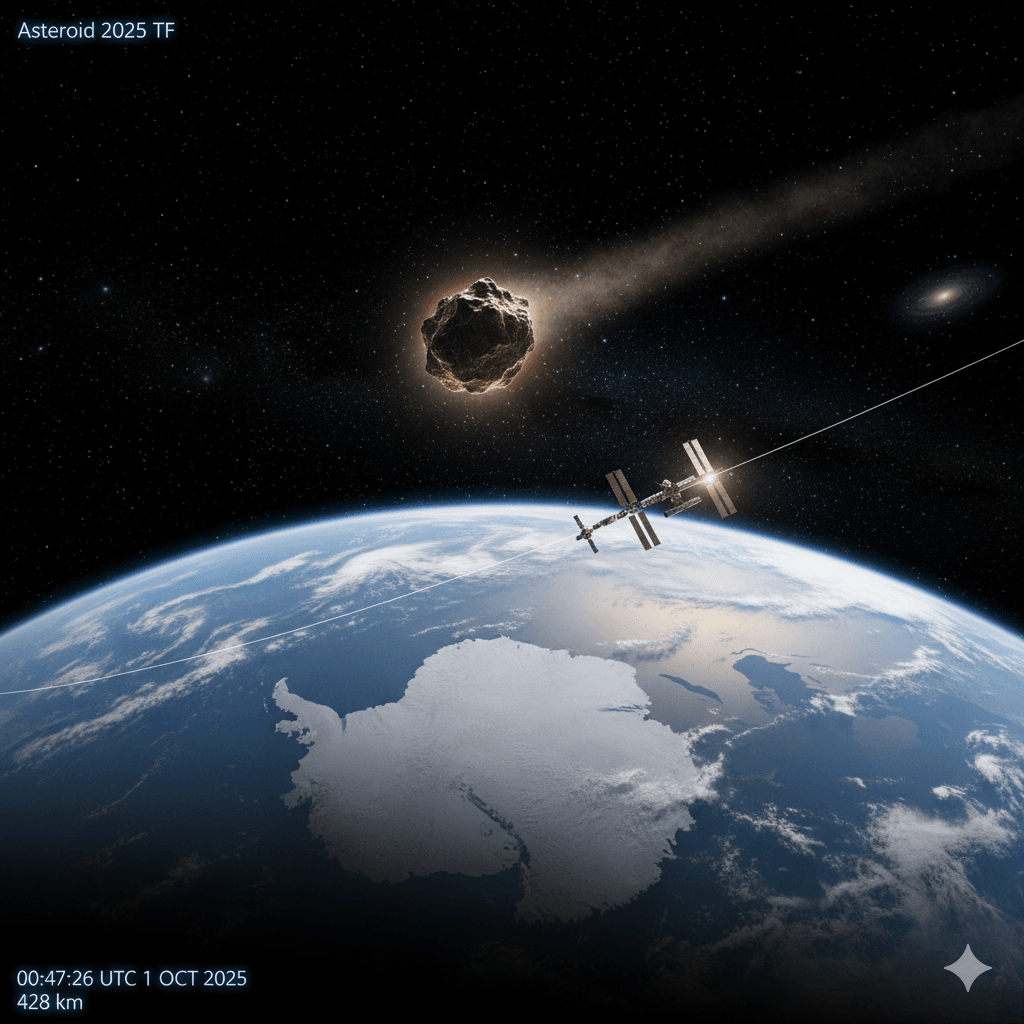
Asteroid 2025 TF: A Close Call From Space
On October 1, 2025, Asteroid 2025 TF made headlines by passing extremely close to Earth — at an altitude nearly the same as the International Space Station (ISS). This marks the second-closest asteroid flyby ever recorded, after 2020 VT4, and highlights the challenges of tracking small near-Earth objects.
Size and Speed
Despite the close proximity, 2025 TF posed no significant threat to Earth due to its small size.
| Characteristic | Value | Notes |
|---|---|---|
| Estimated Diameter | 1–3 meters (3.3–9.8 feet) | Roughly the size of a small car or sofa. It would have burned up harmlessly if it entered Earth’s atmosphere. |
| Relative Speed | 20.9 km/s (13.0 mi/s) | About 75,200 km/h or 46,700 mph. |
| Closest Approach Altitude | 428 ± 7 km (266 miles) | Within the orbital range of the ISS (370–460 km). |
Discovery and Classification
- Discovery Time: Hours after its closest approach.
- Date & Time: October 1, 2025, at 06:36 UTC.
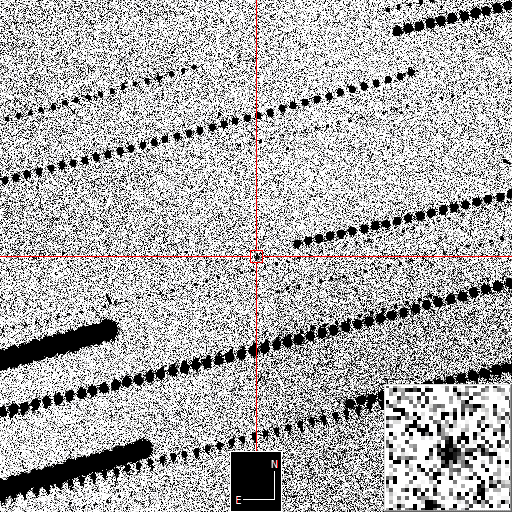
- Discovery Program: Catalina Sky Survey (NASA-funded) using the Bok Telescope at Kitt Peak National Observatory, Arizona.
- Significance: The late detection underscores how difficult it is to track small meter-scale asteroids, especially those coming from the Sun’s direction.
- Classification: Member of the Apollo group of near-Earth asteroids (NEOs).
Future Trajectory
- Next Flyby: Predicted in April 2087.
- Distance in 2087: Approximately 5.97 million km (3.71 million miles), a much safer distance.
While 2025 TF crossed the threshold for a “potentially hazardous” asteroid (closer than 7.48 million km), its tiny size means it does not pose any real danger.

Why This Flyby Matters
Asteroid 2025 TF serves as a reminder of:
- The importance of continuous monitoring of near-Earth objects.
- How meter-sized asteroids can pass unnoticed due to late detection.
- The need for improved early-warning systems to track space objects approaching from sunward directions.
Although this close approach caused excitement in the astronomical community, it was ultimately harmless — a tiny visitor zipping past Earth at record speed and proximity.