


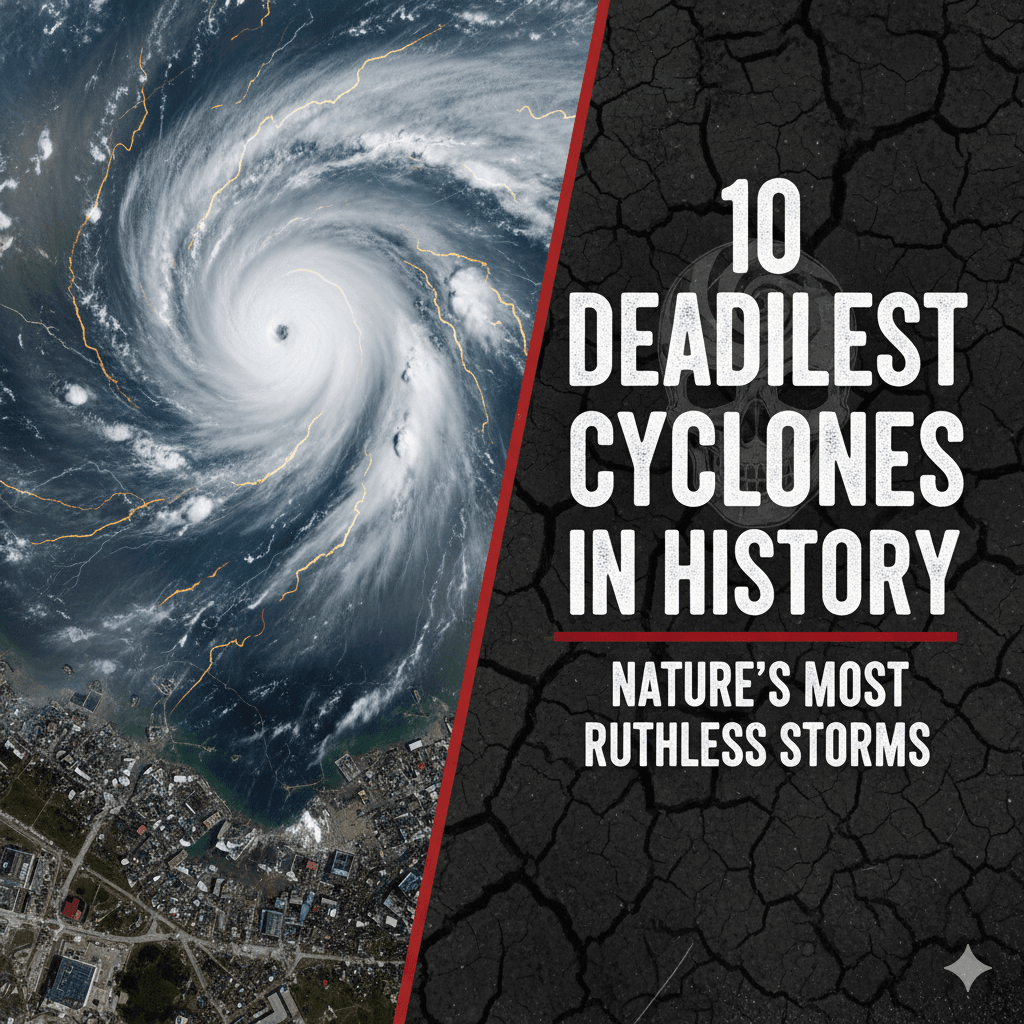
Cyclones are terrifying reminders that Mother Nature doesn’t negotiate. They’ve sunk cities, erased coastlines, and rewritten geography itself.
While modern radar and satellite systems have made early warnings possible, history shows that when nature truly loses its temper — technology often just watches helplessly.
Here’s a look at the 10 deadliest cyclones in human history, each one a brutal lesson written in wind and water.
1. The Bhola Cyclone (1970) — Bangladesh & India
- Year: 1970
- Death Toll: ~300,000 to 500,000
The deadliest cyclone ever recorded. The Bhola Cyclone slammed into what was then East Pakistan (now Bangladesh) with 200 km/h winds and a devastating 10 m storm surge.
Entire islands vanished beneath the Bay of Bengal. The tragedy even influenced politics — fueling tensions that led to Bangladesh’s independence war in 1971.
2. The Hooghly River Cyclone (1737) — India
- Year: 1737
- Death Toll: ~300,000
An early but catastrophic storm that struck near present-day Kolkata (then Calcutta). Ships were hurled inland, entire villages disappeared, and colonial records describe “the river itself rising to the clouds.”
No satellites, no sirens — just chaos.
3. The Haiphong Typhoon (1881) — Vietnam
- Year: 1881
- Death Toll: ~300,000
The Red River Delta was turned into an inland sea. The Haiphong Typhoon struck northern Vietnam with incredible fury, sweeping away tens of thousands of homes and triggering famine across the region.
4. The Coringa Cyclone (1839) — India
- Year: 1839
- Death Toll: ~300,000
The port city of Coringa in Andhra Pradesh was wiped off the map.
The cyclone destroyed over 20,000 ships (yes, ships) and erased the city so completely that it was never rebuilt. Today, Coringa exists only as a ghost village and a warning.
5. The Great Backerganj Cyclone (1876) — Bangladesh
- Year: 1876
- Death Toll: ~200,000
When the storm hit the Meghna River estuary, its surge drowned villages miles inland.
Even worse, cholera and famine followed — killing thousands more in the weeks after. This remains one of South Asia’s darkest natural disasters.
6. The Chittagong Cyclone (1897) — Bangladesh
- Year: 1897
- Death Toll: ~175,000
The Chittagong coast was no stranger to cyclones, but this one was different — winds so strong they stripped the land bare. Survivors described the sky turning “white with water.”
The region’s wooden homes and fishing communities were obliterated overnight.
7. The Bangladesh Cyclone (1991)
- Year: 1991
- Death Toll: ~138,000
Known locally as Cyclone Gorky, it struck with 250 km/h winds and a 6 m storm surge.
Despite warnings, many underestimated its force. The tragedy forced Bangladesh to rethink disaster preparedness — leading to today’s vast network of cyclone shelters and alert systems that now save countless lives.
8. Cyclone Nargis (2008) — Myanmar
- Year: 2008
- Death Toll: ~80,000 to 138,000
When Nargis hit the Irrawaddy Delta, it wasn’t just the storm that killed — it was the politics. Myanmar’s military government initially blocked foreign aid, leaving millions stranded without food or medical help.
It remains one of the worst humanitarian failures in modern Asia.
9. The Calcutta Cyclone (1864) — India
- Year: 1864
- Death Toll: ~50,000 to 100,000
A massive cyclone ripped through Kolkata, capsizing hundreds of ships in the Hooghly River and leveling the city’s early colonial infrastructure.
The aftermath saw widespread disease outbreaks, which claimed nearly as many lives as the storm itself.
10. Other Historic Bengal & Bay of Bengal Cyclones
- Various years: 1789, 1833, 1963, 1965
- Deaths: 10,000–200,000+
Before the 20th century, records were patchy — but the Bay of Bengal has seen repeated catastrophes. These lesser-known storms killed tens of thousands, shaping the world’s understanding of monsoon and cyclone behavior.
Why These Cyclones Were So Deadly
- Geography: Most struck low-lying deltas where millions live barely above sea level.
- Storm Surge: Giant walls of water were deadlier than the winds themselves.
- Poor Warnings: Most hit before radar or satellites existed.
- Aftermath: Famine, cholera, and political mismanagement often killed as many as the storms.
The Silver Lining
Since the 1990s, countries like Bangladesh, India, and Myanmar have made huge leaps in cyclone preparedness — early warning systems, raised shelters, and coordinated evacuations.
A storm like Bhola today would still be devastating, but not apocalyptic.
Cyclones remind us that for all our satellites and supercomputers, we’re still small in the face of nature.
Every one of these disasters left lessons — about preparation, governance, and humility.
And as climate change warms our oceans, those lessons are becoming more vital than ever.
Because history doesn’t just repeat — it returns, angrier and wetter.